 AI Healing
BlogTools & Guides
Computational Wellness and Generative Calm
By AI Healing
In short
Computational wellness is software — procedural geometry, color systems, breath pacers, sound mixers — that supports everyday calm through the senses rather than conversation. Generative calm is the felt result: ambient, responsive media with enough novelty to hold attention and enough repetition to feel safe.
Most conversations about AI for mental health start with chatbots: a text box that listens, reframes, or triages. That is one lane. Another is opening — quietly, without hype — and it looks less like a therapist and more like an environment you can step into.
That lane has names worth learning: computational wellness and generative calm. They describe software that uses algorithms, color theory, geometry, and sound to help your nervous system downshift — not by arguing with your thoughts, but by giving your senses something coherent to follow.
AI Healing lives here. Not as a diagnosis engine. As a studio of responsive wellness media you can use in five minutes, free, with no account.
What is computational wellness?
Computational wellness means using code to support everyday mental health habits: breathing, coloring, ambient visuals, affirmations, and soundscapes. The “computation” is not magic intelligence. It is:
- Procedural geometry — mandalas and spirals generated from mathematical rules instead of static clip art
- Color systems — complementary and triadic palettes chosen so contrast feels intentional, not random noise
- Responsive UI — themes, pacers, and mixers that adapt when you tap, cycle, or shift mood
- Low-friction access — open a page, interact once, feel something change
Computational wellness sits beside clinical care, not in place of it. You would not expect a breath pacer to prescribe medication. You might use one before bed, during a panic spike, or between therapy sessions — the same way people use journals or walks.
The design bet is simple: when cognition is loud, change the channel through the body and the eyes first.
What is generative calm?
Generative calm is the felt experience that comes from media that is made in the moment — or feels alive enough that your brain treats it as fresh.
Static relaxation content can go stale. The tenth time you hear the same meditation script, your mind skims it. Generative calm tries to stay novel without staying chaotic:
- An infinite Energy Vortex zoom where geometry and hue keep moving
- A Healing Mandala you fill with palettes tuned for contrast
- Healing music you mix from frequency presets instead of one fixed track
- Affirmation layouts that reflow when you change words or wave settings
The goal is not stimulation for its own sake. It is structured novelty — enough variation to hold attention, enough repetition to feel safe.
Researchers talk about “soft fascination” in restorative environments: your mind engages lightly while stress hormones ease. Generative calm aims for that zone. Person-dependent, always — some days it clicks, some days it does not.
How the two ideas fit together
| Idea | Emphasis |
|---|---|
| Computational wellness | The how — algorithms, palettes, pacers, procedural art |
| Generative calm | The feel — ambient, responsive, never quite the same twice |
Together they describe a frontier that is not primarily conversational. It is sensory and spatial: color that shifts, spirals that pull inward, rhythms you can see and hear.
That is different from the App Store shelf labeled “mental health,” where most tiles still promise better habits through notifications and streaks. Computational wellness can include gamification — streaks and levels have their place — but the core value is immediate atmosphere, not homework.
Shift Mood: computational wellness in one tap
In the AI Healing header, Shift Mood replaces a generic “theme randomizer” label with what the button actually does: it rotates the site through complementary color pairs built from color theory, then saves your choice locally.
Tap once — the calm blues and warm accents re-tune. Tap again — another mood. Shift+click resets the default palette.
That is computational wellness at UI scale. You are not configuring hex codes. You are saying: this color world feels closer to where I am right now. For some people that is a small cosmetic tweak. For others, especially when anxiety makes everything feel visually “loud,” it is a grounding ritual before they open a mandala or breath pacer.
Generative calm across the studio
Energy Vortex and the Heal cycle
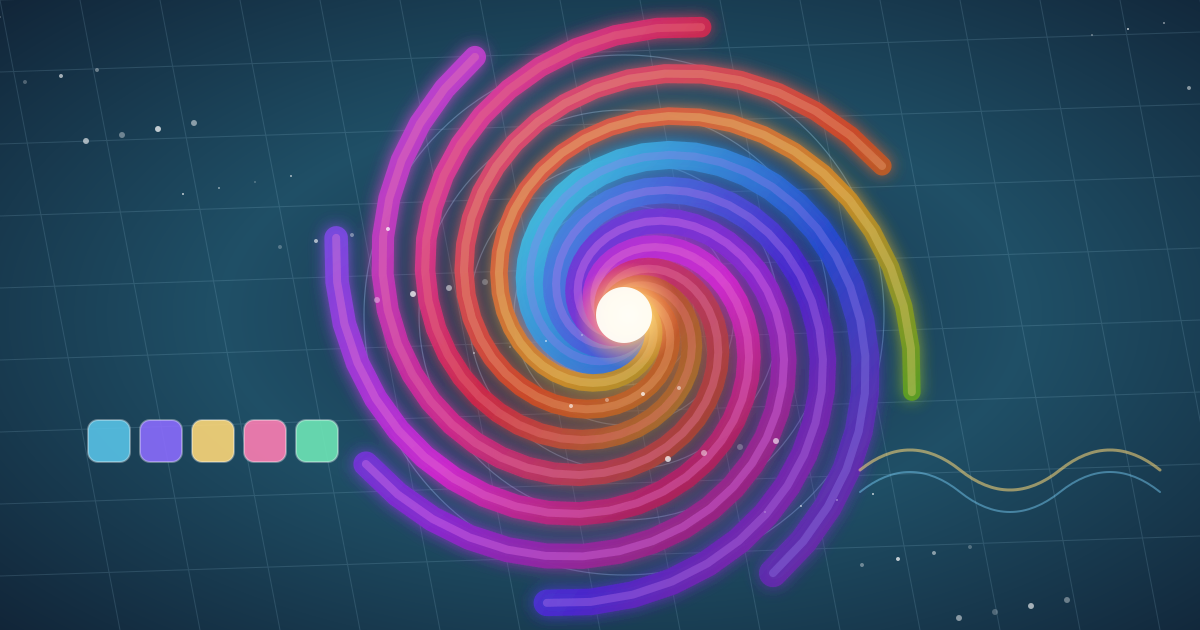
The Energy Vortex renders an infinite Krystal spiral — eight-fold geometry with a continuous zoom. Tap Heal and the vortex cross-dissolves through curated multicolor palettes ordered for maximum contrast, then returns to the original rainbow spectrum.
Each step is a distinct visual mood: ruby gold, seafoam teal, violet flame, full ascension spectrum. You are not picking colors manually. You are cycling atmospheres until one matches your body state.
Healing Mandala
Healing Mandala combines procedural templates with a coloring engine. Shapes are fillable regions, not a flat PNG. Palettes use complementary schemes so neighboring wedges stay readable and satisfying to complete.
This is therapy artwork in the experiential sense: slow hands, radial symmetry, no scoreboard required.
Breathwork and music
Box breathwork ties animation to inhale, hold, and exhale — computation in the service of rhythm. Healing music layers Solfeggio tones and binaural offsets you adjust yourself. Both are generative in the weak sense: your session parameters make the output, even when the underlying oscillators are deterministic.
Affirmations
The affirmation generator wraps language in wavy retro layout — words as visual object, not bullet points in a notes app. Changing copy or spacing regenerates the poster. For people who ruminate in sentences, seeing a phrase rendered as art can land differently than reading it in system font.
Why this feels like frontier AI for mental health
“Frontier” does not have to mean the largest language model. It can mean a new surface area: wellness tools that are computational first and conversational never.
Three reasons this niche is underbuilt:
- Most funding chases chat. Investors understand “AI therapist.” Procedural calm is harder to demo in a pitch deck.
- Evidence is diffuse. Coloring, guided imagery, and music therapy have literature — but not always packaged as “AI products” with RCTs behind each feature.
- Taste matters. Bad generative art is agitating. Good generative calm requires color science, motion design, and conservative claims.
AI Healing’s positioning is intentionally narrow: sub-clinical wellness, honest language, tools that work offline in the browser after load. No signup wall. No pretend diagnosis.
That is frontier in the sense of ** unexplored product shape**, not frontier in the sense of replacing clinicians.
Computational wellness vs. clinical AI
| Computational wellness | Clinical / regulated AI | |
|---|---|---|
| Typical claim | Calm, focus, creative grounding | Treat, diagnose, monitor risk |
| Interaction | Visual, auditory, tactile | Often text or structured assessments |
| Regulation | Usually consumer wellness | Often medical device or HIPAA-heavy |
| Best use | Daily habits, between sessions | Care plans, escalation paths |
| Risk profile | Low when claims stay honest | Higher — wrong advice can harm |
Use both lanes if you need both. Do not confuse them.
A five-minute practice you can try tonight
- Open AI Healing.
- Tap Shift Mood until the site colors feel tolerable — not perfect, just not irritating.
- Open the Energy Vortex. Watch for two minutes without trying to breathe “correctly.”
- If your body wants structure, switch to box breathwork for four cycles.
- Close the tab. No journal prompt unless you want one.
That is a complete computational wellness session. No streak required.
Who this helps most (and who should look elsewhere)
Often a fit:
- People with mild anxiety or stress who want something immediate
- Visual thinkers who color, doodle, or watch motion to settle
- Anyone between therapy appointments who needs a sensory reset
Look elsewhere first:
- Active suicidal ideation or self-harm — contact local emergency services or a crisis line
- Severe or persistent symptoms — a licensed clinician, not a mandala app
- Anyone expecting an app to replace medication or diagnosis
Generative calm is a complement. Treat it that way.
FAQ
Is computational wellness the same as digital therapeutics?
No. Digital therapeutics (when cleared or approved) target specific conditions with clinical evidence and regulatory oversight. Computational wellness tools like AI Healing target everyday grounding with conservative, non-clinical language.
Do I need to understand color theory to use Shift Mood or Heal?
No. The palettes are built from complementary and triadic relationships behind the scenes. You only choose what feels better in the moment.
Is generative calm just psychedelic art?
It can overlap visually — spirals and saturated palettes show up in both worlds — but generative calm here is paced for downshifting, not overwhelm. Contrast-ordered Heal cycles and soft site themes are tuned so consecutive steps feel distinct, not blurring.
Where does “AI” fit if there is no chatbot?
AI Healing uses the phrase in the brand sense: intelligent, responsive software — procedural generation, palette systems, and curated wellness tooling — not a large language model acting as your therapist. For many users, that is the point.
Can I use these tools with therapy?
Often yes. Some therapists welcome exported mandalas or breath logs as session starters. Ask your provider what fits your plan.
The longer view
Mental health technology will keep splitting: conversation engines on one side, computational environments on the other. The second path is easier to miss because it does not screenshot well on Twitter. It reveals itself when you are anxious at midnight, you open a spiral, the colors shift, and your shoulders drop half an inch without anyone typing a paragraph at you.
That is computational wellness. That is generative calm. And it is worth building in public — carefully, without overclaiming — as a third way beside meditation libraries and chatbot coaches.
Non-clinical wellness information only — not medical advice.